
LPPOM’s IPRA 2026 recognition highlights the growing importance of institutional reputation, public trust and policy support for Indonesia’s halal economy.
Indonesia’s expanding halal economy is creating a growing need for institutions that can provide credible assurance, professional services and reliable information to businesses and consumers. As halal products become increasingly integrated into mainstream economic activity, public trust is emerging as an important component of the country’s broader halal ecosystem.
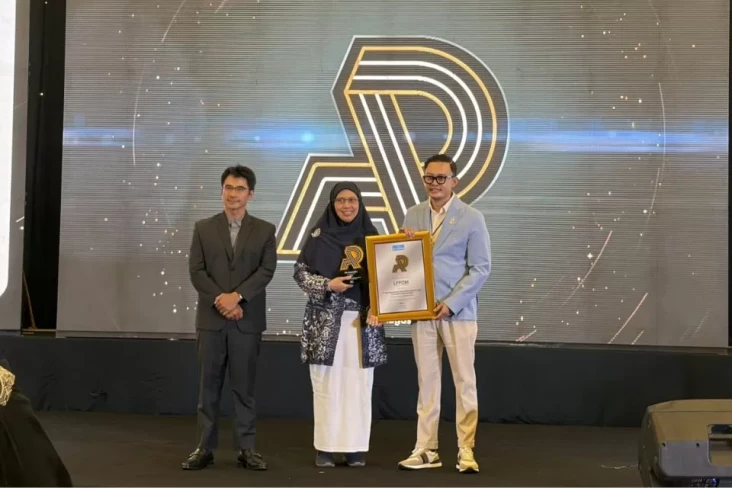
This context is reflected in the recognition received by LPPOM at the Indonesia Public Relations Awards (IPRA) 2026, where the organisation was recognised in the Corporate Reputation category for the Non-Governmental Organization sector. The award highlights an increasingly relevant question for Indonesia’s halal industry: how can institutions maintain public confidence while responding to regulatory, technological and market changes?
For an organisation involved in halal inspection and assurance, reputation is closely linked to institutional performance. Consumers need confidence that halal claims are supported by credible processes, while businesses need assurance that the systems they use are professionally managed.

The issue also has a public-policy dimension. A reliable halal ecosystem requires cooperation between government institutions, certification and inspection bodies, laboratories, businesses, consumers and other stakeholders.
Reputation Beyond Public Relations
The growing importance of institutional reputation reflects a change in the relationship between organisations and the public.
In the past, reputation was often approached primarily through corporate communications. Today, public perception is increasingly shaped by direct experience, transparency, technical competence and the organisation’s ability to respond to changing expectations.
This is particularly relevant for LPPOM because its work operates in an area where public confidence is fundamental.
A strong communication strategy can explain an organisation’s role, but long-term credibility depends on whether the organisation consistently delivers on its responsibilities.
The laboratory infrastructure associated with LPPOM provides an example of this connection between communication and technical capability. The LPPOM laboratory describes itself as an ISO/IEC 17025:2017-accredited halal and vegan testing laboratory, providing testing services for sectors including food and beverages, cosmetics, pharmaceuticals and packaging.
Public Trust as Economic Infrastructure
Public trust is often discussed as an intangible concept, but its economic consequences can be significant.
When consumers trust halal assurance mechanisms, they can make purchasing decisions with greater confidence. When businesses trust testing and inspection processes, they can manage compliance requirements more effectively.
This creates an institutional layer supporting economic transactions.
For Indonesia, the issue becomes increasingly important as halal products move beyond traditional food and beverage markets into cosmetics, pharmaceuticals, hospitality, packaging and other sectors.
The LPPOM laboratory currently lists services covering chemical, microbiological and molecular testing, calibration, training and consultation. Its services are available to businesses ranging from SMEs to multinational companies.
The breadth of these services illustrates how halal assurance is becoming connected with wider questions of product quality and safety.
Regulation and Institutional Readiness
The development of Indonesia’s halal ecosystem is also closely linked to public policy.
Government regulations establish requirements for halal product assurance, including requirements related to halal inspection institutions and supporting infrastructure.
Government Regulation No. 39 of 2021, for example, sets requirements concerning the establishment and accreditation of Halal Inspection Bodies, including requirements relating to auditors, offices and laboratory capabilities or cooperation with laboratories.
This regulatory framework illustrates why institutional capability matters.
The effectiveness of a policy does not depend solely on the existence of regulations. It also depends on whether the institutions supporting implementation have sufficient competence, infrastructure and public credibility.
The Importance of Technical Capacity
Policy implementation in a technically complex sector requires more than administrative compliance.
Modern products can involve numerous ingredients, processing aids and supply-chain stages. Some materials may require specialised testing to establish their characteristics and potential contamination.
LPPOM’s laboratory states that it has been accredited by the National Accreditation Committee under ISO/IEC 17025 since September 2016 and has developed specialised testing capabilities, including real-time PCR analysis for porcine DNA.
The laboratory also says it has expanded physical, chemical and microbiological testing capabilities in response to demand, including demand from international clients.
Such infrastructure can strengthen the practical side of halal assurance.
Supporting SMEs
The policy conversation around the halal economy also needs to consider small and medium-sized businesses.
SMEs are important contributors to Indonesia’s economy, but smaller businesses may face challenges in understanding standards, preparing documentation, accessing testing services and adapting production processes.
Professional support can therefore determine whether halal requirements become a barrier or an opportunity.
The LPPOM laboratory explicitly states that it serves both SMEs and multinational companies. Its services include testing and sampling, training, consultation and other technical support.
Accessible technical infrastructure can help businesses understand requirements and improve product quality while preparing for certification.
The Regional Policy Dimension
The implications extend beyond Indonesia’s domestic market.
ASEAN economies are increasingly interconnected through supply chains, tourism, investment and consumer markets. Halal products can therefore become part of broader regional economic strategies.
Indonesia’s experience in developing halal assurance institutions may provide lessons for other countries seeking to strengthen their own halal ecosystems.
At the same time, differences between national certification systems and regulatory approaches can create challenges for companies operating across borders.
Greater dialogue and institutional cooperation could help businesses navigate these differences.
Reputation and Policy Effectiveness
From a public-policy perspective, institutional reputation should be considered part of policy effectiveness.
A regulation may establish a clear requirement, but businesses and consumers must still understand and trust the institutions responsible for implementing or supporting that requirement.
This makes communication important.
However, communication must be supported by institutional capability.
For LPPOM, the combination of technical testing, professional services, training and consultation provides an example of how institutional functions can complement public communication.
The result is a more comprehensive approach to building confidence.
Leadership in a Changing Ecosystem
Leadership also becomes important when institutions operate in a rapidly changing environment.
The recognition received by LPPOM places attention not only on the organisation itself but also on the leadership and people behind its operations.
For an institution dealing with standards and public trust, leadership must balance continuity with adaptation.
The organisation needs to preserve established principles while responding to new technologies, changing business models and evolving regulatory expectations.
That challenge is likely to become more pronounced as Indonesia seeks to strengthen its position in the global halal economy.
Technology and the Future of Assurance
Technology is another factor changing the halal assurance landscape.
Laboratory analysis increasingly depends on sophisticated testing methods, while digital platforms can improve interactions between institutions and businesses.
LPPOM’s online laboratory service platform, for example, provides digital access to testing and related services. The organisation also offers training and seminars covering areas such as ISO 17025 awareness, halal testing, calibration and method development.
Digitalisation can make technical services more accessible, but it also raises expectations for speed, transparency and user experience.
Institutions will therefore need to combine technological capability with strong professional standards.
A Broader Definition of the Halal Economy
The halal economy should not be understood simply as a market for products labelled halal.
It is an ecosystem involving standards, supply chains, testing, certification, consumer education, business development and regulatory oversight.
Within that ecosystem, trust functions as a connecting element.
Businesses need it to enter markets. Consumers need it to make informed decisions. Regulators need it to support effective implementation. Institutions need it to maintain credibility.
LPPOM’s recognition at IPRA 2026 therefore offers a useful perspective on a much broader issue: the role of institutional reputation in supporting economic development.
Looking Ahead
As Indonesia continues to develop its halal economy, the next stage will require stronger coordination among institutions.
Government agencies, halal inspection bodies, laboratories, industry associations, businesses and consumer organisations will all have roles to play.
The objective should not only be to increase the number of certified products, but also to improve the quality, efficiency and credibility of the overall system.
For Indonesia, that could strengthen both domestic consumer confidence and the competitiveness of Indonesian businesses seeking access to regional and international markets.
Conclusion
LPPOM’s recognition at the Indonesia Public Relations Awards 2026 highlights an issue that extends beyond corporate communications.
Institutional reputation is becoming increasingly connected to public policy, economic confidence and the effectiveness of the halal ecosystem.
For Indonesia, maintaining that reputation requires more than public visibility. It requires technical competence, professional standards, transparent communication and consistent engagement with businesses and consumers.
The LPPOM laboratory’s accredited testing capabilities and services for multiple industries demonstrate how technical infrastructure can support that broader objective.
The policy challenge ahead is to ensure that these institutional capabilities continue to evolve alongside the halal economy.
As regional markets become more integrated, trust will increasingly determine how effectively businesses can move across borders.
In that environment, reputation is not simply an image.
It is part of the infrastructure that allows an economic ecosystem to function.
Sources
SINDOnews — Reputasi dan Kepercayaan Jadi Fondasi Penting bagi Organisasi