



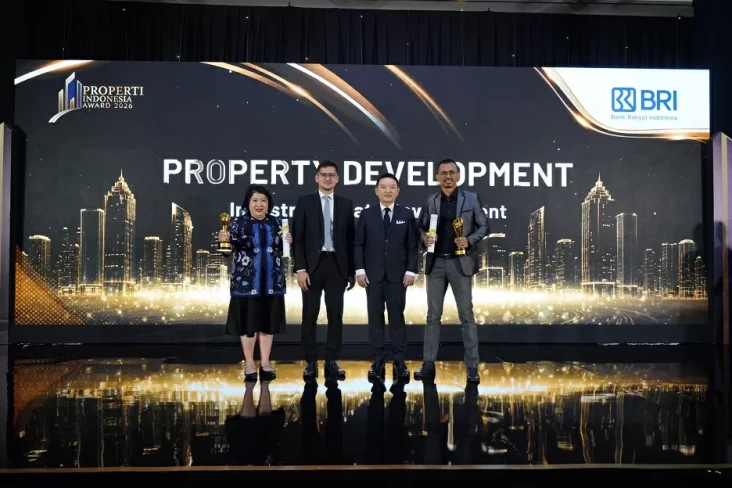
Jababeka Bizpark’s Indonesia Property Award 2026 recognition highlights how flexible business space and integrated industrial ecosystems are evolving in Indonesia and Asia.
CIKARANG, Indonesia — Across Asia, industrial districts are increasingly evolving beyond conventional manufacturing clusters. As companies adjust to changing production models, distribution networks and expansion requirements, the infrastructure surrounding businesses is becoming an increasingly important part of the investment equation.
In Indonesia, the development of Jababeka Bizpark offers one example of this broader transition. The project, developed by PT Graha Buana Cikarang, a subsidiary of PT Jababeka Tbk, received the Indonesia Property Award 2026 in the Property Development category, under the Industrial Estate Development subcategory. The award was presented at JW Marriott Hotel Jakarta on August 26, 2026.
The recognition comes as demand for flexible business premises grows within established industrial areas. Jababeka says the demand is coming not only from new businesses, but also from existing companies seeking additional space to support expansion and the development of their operations.

That changing requirement is reflected in the design of Jababeka Bizpark. The development is conceived as a multipurpose building that can accommodate storage, production, distribution and commercial activities. Its high-ceiling configuration also allows the internal space to be developed up to three floors, depending on users’ requirements.
Beyond the Traditional Industrial Estate
The evolution of industrial property is particularly relevant in Asia, where established manufacturing centers are increasingly connected to logistics, commercial and service networks. In such environments, the value of a business location is influenced not only by the building itself, but also by the infrastructure and economic activity surrounding it.
Jababeka Bizpark is located within Kota Jababeka, an integrated development that has evolved for more than three decades. The wider ecosystem combines industrial, business, residential and educational activities, supported by infrastructure and other facilities. Jababeka reports that the area is home to more than 2,000 companies and around 1.2 million people.
Connectivity is another component of the model. Kota Jababeka is supported by four toll-road accesses and Cikarang Dry Port, infrastructure that supports connectivity and logistics activity. For businesses involved in manufacturing, distribution or other activities dependent on the movement of goods, these connections can form part of their operational considerations.
The significance of this ecosystem extends beyond physical infrastructure. A concentration of companies can also create opportunities for business networking and collaboration, while the presence of supporting facilities can reduce the separation between industrial activity and other commercial functions.
This is consistent with a wider shift in the role of industrial estates across Asia. Many established industrial districts are no longer simply collections of factories. They are increasingly becoming integrated economic environments in which manufacturing, logistics, commercial activities, infrastructure and human resources interact.
Flexibility and Business Expansion
For companies, flexibility can become particularly important when expansion does not follow a predictable path. A business may begin by using a property for storage, later add production activities, or require additional space for distribution and commercial operations.
Jababeka Bizpark’s multipurpose configuration is designed around that possibility. Rather than defining the property around a single operational function, the concept allows users to adapt the available space to different business requirements.
The development has also moved beyond the planning stage. In April 2026, Jababeka completed the simultaneous handover of Phase I Bizpark units to consumers. The company described the project as combining strategic location, competitive pricing and flexible building design.
Jababeka reported that the first phase included several unit configurations and that the units in the first phase had sold out. The second phase introduced a 2-in-1 concept, with reported absorption reaching 90 percent at the time of the company’s April announcement.
From an investment perspective, the project is offered starting at IDR 1.65 billion, with financing alternatives supported through partnerships with banks.
Cikarang in a Wider Asian Context
The development also needs to be viewed against the continuing role of Cikarang as an important industrial area within Indonesia. The region’s established industrial base places it within the country’s broader manufacturing and logistics network, while its infrastructure connects business activity with major transportation routes.
The wider market remains active. ANTARA reported in March 2026 that PT Jababeka Tbk targeted marketing sales of Rp3.75 trillion for 2026, up from Rp3.2 trillion in 2025. The company said continued demand for industrial land in Cikarang and Kendal was among the factors supporting the target.
The figures provide context for the continued development of industrial property in Indonesia. They also show how demand for industrial land and related commercial products remains part of a broader property-market dynamic.
At the same time, the changing nature of industrial estates raises a wider question for Asian economies: how can existing industrial clusters accommodate businesses that require more flexible combinations of production, storage, distribution and commercial space?
Projects such as Jababeka Bizpark represent one response to that question. Rather than creating a standalone business location, the development is positioned within an existing ecosystem where infrastructure, companies and supporting facilities are already present.
An Ecosystem Approach to Property
Ivonne Anggraini, Director of PT Graha Buana Cikarang, has emphasized that contemporary property development needs to consider more than the physical structure. From the company’s perspective, a property should connect with the surrounding ecosystem, connectivity and opportunities for business growth.
That approach reflects an increasingly important principle in Asian industrial development: infrastructure becomes more valuable when it is integrated with the economic environment around it.
For investors and business owners, the consideration therefore extends beyond the purchase or lease of a building. Access to transportation, proximity to established companies, availability of supporting services and the potential for business networking can all contribute to the practical value of a location.
Jababeka Bizpark’s recognition at the Indonesia Property Award 2026 provides a timely illustration of that changing landscape. Its award is linked to a property concept designed around flexibility, but its wider relevance comes from its position within an established industrial ecosystem.
As Asian economies continue to develop interconnected production and distribution networks, the industrial estate itself is becoming part of a larger economic infrastructure. Cikarang’s continuing development, and Jababeka Bizpark’s positioning within that environment, offer a case study of how Indonesian business districts are adapting to the changing requirements of modern enterprises.