

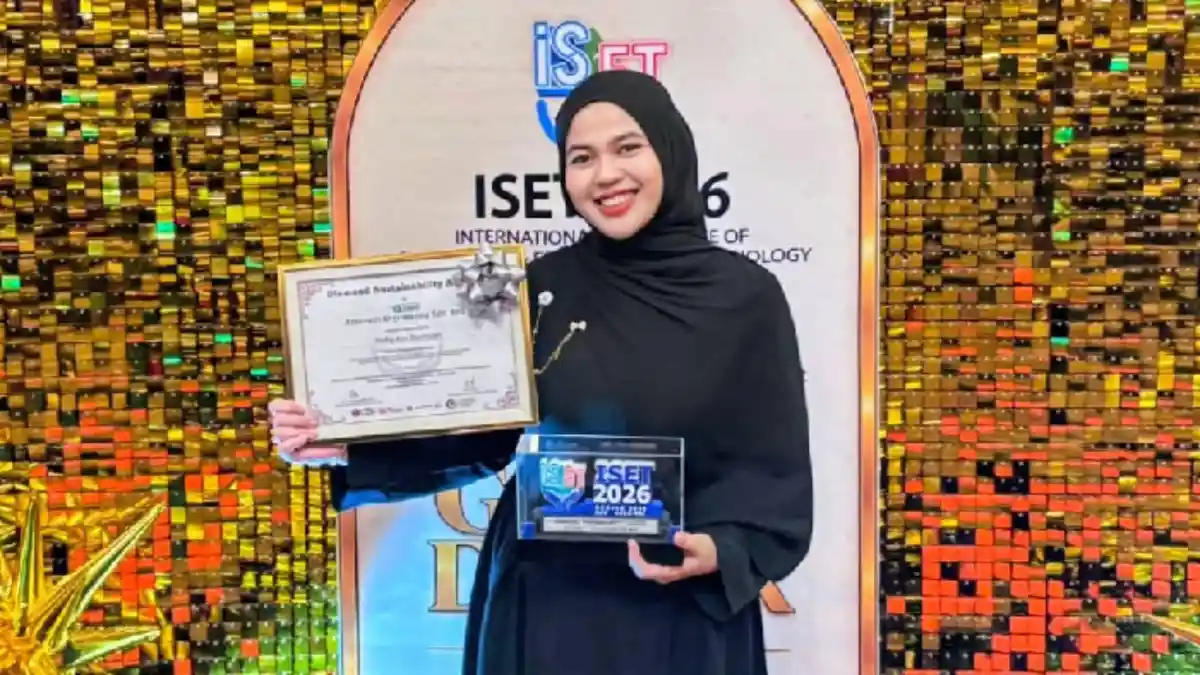
Wafiq Alni Dzulhijjah’s award-winning Sigupai rice husk research highlights opportunities for circular economy, sustainable materials and regional innovation in Southeast Asia.
A rice field in Aceh may seem far removed from the laboratories and technology centers shaping Southeast Asia’s sustainability agenda. Yet research into one local rice variety is demonstrating how agricultural resources can become part of a much wider conversation about innovation, environmental technology and the circular economy.
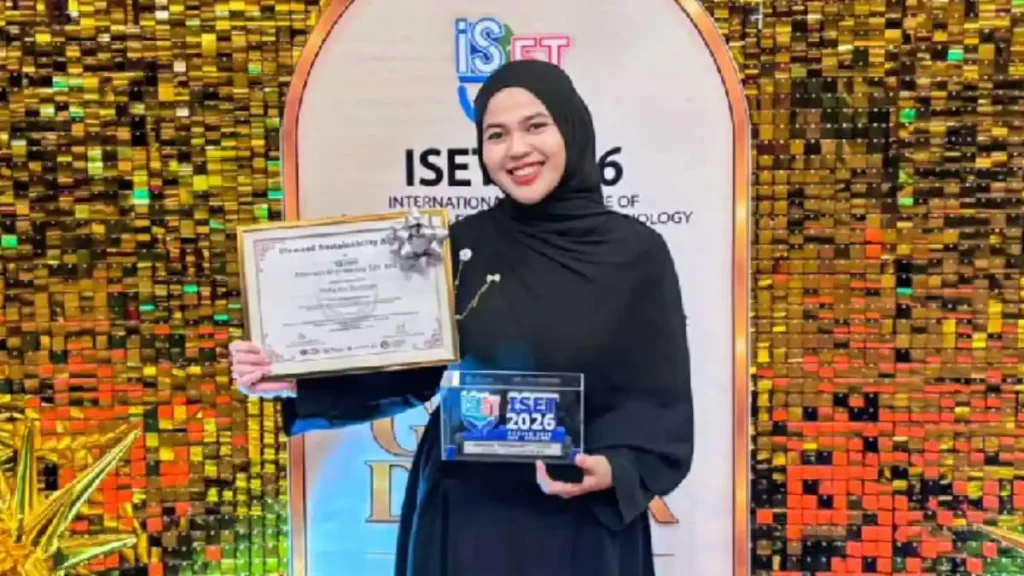
Researcher Wafiq Alni Dzulhijjah has received international recognition for research involving rice husk from the Sigupai variety, a local rice variety associated with Aceh. Her work explores how agricultural residue can be processed into advanced materials with potential relevance to environmental and water-treatment technologies.
Wafiq, a doctoral researcher at Universitas Syiah Kuala’s School of Engineering, has research interests that include membrane technology, water purification, and water and wastewater treatment. Her research places an agricultural by-product within a broader technological context involving materials science and environmental engineering.
The research gained international attention when Wafiq received the Diamond Sustainability Award 2026 at the International Conference of Sustainable and Environmental Technology 2026 in Johor Bahru, Malaysia, held from 22 to 24 September 2026. The recognition was associated with her work on Sigupai rice husk and advanced membrane technology.
The significance of the research extends beyond the award itself. It raises a policy-relevant question for agricultural economies across Southeast Asia: how can locally available biological resources be transformed from waste streams into higher-value materials?
From Agricultural Residue to Research Material
Rice husk is an abundant agricultural residue in rice-producing countries. Traditionally, its management has often been approached as a waste-disposal issue. Scientific research, however, increasingly looks at agricultural residues as potential feedstocks for materials, chemicals, energy and other products.
In the Sigupai case, research has examined the production of nanosilica from rice husk waste. A study published in Case Studies in Chemical and Environmental Engineering investigated the synthesis and characterization of nanosilica derived from Sigupai rice husk, demonstrating the material potential contained within the residue.
Further research has investigated nanocellulose derived from Sigupai rice husk through acid hydrolysis. Nanocellulose has attracted interest for sustainable-material applications, including composites and packaging.
Another research direction connects rice-husk-derived nanosilica and nanocellulose with thin-film nanocomposite membranes. The research examines their potential as antifouling agents, connecting agricultural waste valorization with membrane-based water-treatment technology.
The progression is notable because it illustrates a chain of innovation: an agricultural residue becomes a source of functional materials, and those materials are then investigated for use in technologies addressing environmental challenges.
A Policy Question for Southeast Asia
For Southeast Asian countries, this approach has potentially important policy implications.
Agriculture remains deeply connected to rural livelihoods, food systems and regional economies. At the same time, governments and industries face increasing pressure to improve resource efficiency, reduce waste and develop more sustainable production systems.
This creates an opportunity for policies that encourage research into agricultural by-products while supporting the infrastructure needed to move promising research beyond laboratories.
The challenge, however, is not simply to identify another use for agricultural waste. A sustainable value chain must also consider collection systems, transportation, processing costs, energy requirements, chemical use, environmental impacts and the consistency of raw materials.
These considerations become particularly important when research moves toward industrial scale.
A laboratory demonstration may establish that a material can be produced. Industrial deployment requires a much broader set of questions: Can the feedstock be supplied consistently? Can the process operate economically? Can quality be controlled? What is the environmental footprint? And can the resulting material compete with existing alternatives?
These are not obstacles unique to Sigupai research. They are central questions across the global field of agricultural waste valorization.
Universities as Innovation Platforms
The Sigupai research also illustrates the role universities can play in regional innovation ecosystems.
Universities are not only centers for academic knowledge. They can function as platforms where local resources, scientific expertise and environmental challenges are brought together.
In this case, research based on an agricultural resource from Aceh has moved into an international scientific setting in Malaysia. Such movement creates opportunities for researchers to exchange knowledge, establish scientific networks and compare local research findings with developments elsewhere in the region.
For Southeast Asia, stronger connections between universities, government research institutions and industry could help create pathways for agricultural-waste research to progress from scientific publications toward tested applications.
The private sector can also have a role, particularly when research reaches the stages of process development, quality assurance and commercialization assessment.
However, collaboration should be based on evidence. Not every promising laboratory material will become a commercially viable product, and technology-transfer programs need mechanisms for evaluating technical and economic feasibility before large-scale investment.
Local Resources, Regional Relevance
One of the most interesting aspects of the Sigupai story is its local origin.
Innovation is often associated with large laboratories, major corporations or metropolitan technology clusters. Yet scientific value can also emerge from resources that are deeply rooted in local communities.
Sigupai rice represents an example of local agricultural identity becoming relevant to advanced-material research. The focus on its husk shows that agricultural biodiversity can have research value beyond the primary product itself.
This perspective is consistent with a broader circular-economy approach. Instead of viewing production systems as a straight line from resource extraction to consumption and disposal, circular models seek opportunities to retain materials in productive use for longer.
Agricultural residues can potentially become part of such systems, provided that their environmental and economic performance is demonstrated.
For policymakers, the lesson is not that every agricultural residue should immediately become an advanced material. Rather, the opportunity lies in creating an environment where promising ideas can be scientifically tested and, where justified, developed further.
From Recognition to the Next Research Stage
Wafiq’s international award provides visibility for the research, but the next stages remain equally important.
Further development could require additional testing of membrane performance, material stability, antifouling behavior, process efficiency and long-term environmental performance. Scale-up would introduce additional technical and economic considerations.
Such work could also benefit from multidisciplinary collaboration. Materials scientists, chemical engineers, environmental researchers, agricultural experts and industry practitioners can contribute different perspectives to the same value chain.
This is where a local research project can potentially become part of a regional innovation ecosystem.
The ASEAN region has diverse agricultural resources and different levels of technological capacity. Sharing research methodologies and building collaborative networks could help researchers compare approaches to agricultural-waste utilization across different countries.
The experience also underscores the importance of maintaining a connection between scientific research and local realities. A technology designed around local feedstocks needs to account for the characteristics of those resources and the communities and industries that manage them.
A Broader Southeast Asian Perspective
The story of Sigupai rice husk is therefore not simply about converting one type of waste into another material.
It is about how Southeast Asia can approach sustainability through research that starts with resources already present within its communities.
From Aceh to Malaysia and potentially to wider regional research networks, the journey illustrates how local scientific work can participate in broader conversations about circular production, environmental technology and resource efficiency.
For policymakers and research institutions, the opportunity is to build systems that allow such ideas to be evaluated rigorously: funding early-stage research, strengthening laboratory capacity, encouraging university-industry collaboration, supporting intellectual-property development and creating pathways for responsible scale-up.
The ultimate measure of success will not be the novelty of the raw material alone, but whether the resulting technology can demonstrate measurable environmental, technical and economic value.
Wafiq’s recognition in Malaysia provides one visible milestone in that process. The larger story is the possibility that agricultural resources traditionally treated as waste can become starting points for new research and innovation.
In a region where agriculture, environmental sustainability and technological development increasingly intersect, the Sigupai case offers a compelling example of how local knowledge and scientific research can meet on a regional stage.