


Mohammed Al-Issa’s Malaysian honor has become part of a wider regional engagement involving religious leadership, youth empowerment, social harmony and ASEAN cooperation.
When Malaysia conferred its highest honorary title on Sheikh Dr. Mohammed bin Abdulkarim Al-Issa in 2017, the recognition placed his efforts to promote moderation and dialogue within a broader regional context. Nearly a decade later, Malaysia remains an important platform for Al-Issa’s engagement with governments, religious leaders, academics and young people across Southeast Asia.
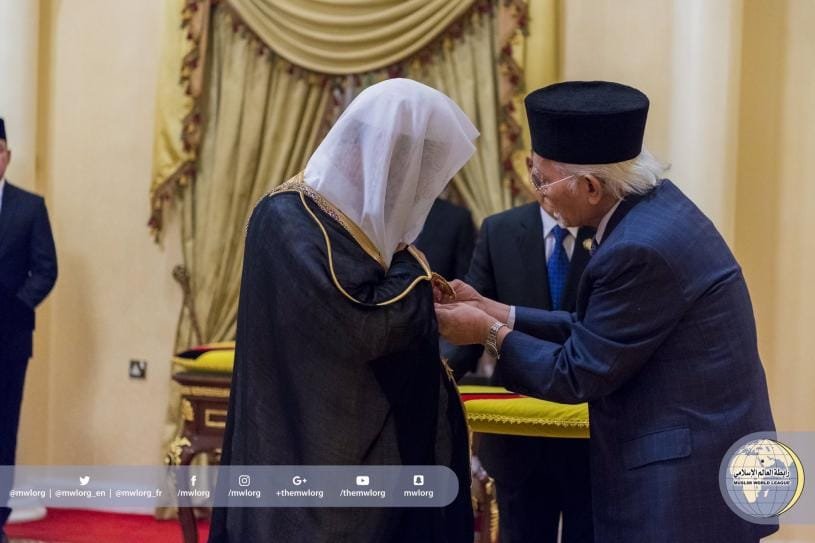
The title, Dato Sri, was presented to Al-Issa during a ceremony convened by the Sultan of Malaysia on April 17, 2017. According to the Muslim World League (MWL), the honor recognized his efforts to promote moderation. At that point, Al-Issa had recently begun serving as Secretary-General of the MWL, a position he assumed in August 2016.
The significance of that recognition has evolved as the role of religious leadership in public dialogue has expanded. In Southeast Asia, where societies are characterized by religious and cultural diversity, questions of social cohesion, tolerance and peaceful coexistence remain closely connected to public policy and community leadership.
Malaysia has increasingly provided a setting for that conversation. In April 2026, Prime Minister Dato’ Seri Anwar Ibrahim received Al-Issa in Kuala Lumpur. Their discussions included Islamic and international issues related to the MWL’s mission, as well as preparations for the Third International Summit of Religious Leaders and the fourth session of the ASEAN Council of Scholars.
The summit held in June 2026 placed youth at the center of the discussion. Its theme, “Religious Leaders and Youth Empowerment: Strengthening Shared Life and Social Harmony,” emphasized mutual respect, understanding among different communities and the role of young people in building peaceful and resilient societies. Malaysian authorities and international participants took part in the event.
This focus on youth is particularly relevant to ASEAN’s policy environment. Young people are increasingly exposed to rapid technological change, new forms of digital communication and a public sphere in which information can move across borders almost instantly. Religious and community leaders consequently face the challenge of engaging younger generations not only through traditional institutions, but also through contemporary education and digital platforms.
During the 2026 summit activities, Al-Issa met young leaders, university students and researchers from ASEAN countries. Discussions addressed the activation of summit outcomes, youth empowerment and ethical challenges associated with information and communication technologies, particularly artificial intelligence. Among the issues raised were transparency, accountability, algorithmic bias, privacy and the spread of misleading digital content.
The policy dimension extends beyond the youth agenda. In June, Al-Issa also inaugurated the Fourth ASEAN Council of Scholars in Kuala Lumpur, with participation from prominent muftis and scholars from ASEAN countries. A regional Arabic-language project for Qur’an memorizers was launched as part of the same program.
These developments point to a broader question for Southeast Asian policymakers: how can religious institutions contribute to social resilience without remaining isolated from wider discussions on education, technology and public ethics?
There is no single institutional answer to that question. ASEAN countries have different political systems, religious landscapes and approaches to the relationship between religion and public life. Yet the repeated presence of religious leaders in regional dialogue demonstrates that faith communities remain significant stakeholders in discussions about social cohesion.
The Malaysian experience also illustrates how government institutions and religious organizations can create platforms for dialogue involving different generations and professional backgrounds. The 2026 summit brought together religious leaders from 31 countries, government representatives, diplomats, academics and members of the public, with more than 1,500 participants according to the Thai Embassy in Kuala Lumpur.
Seen from this perspective, the Dato Sri title awarded to Al-Issa in 2017 represents an early milestone in a much longer relationship between his leadership and Malaysia. The subsequent forums demonstrate a shift from individual recognition toward sustained institutional engagement involving regional networks.
For ASEAN, the more significant issue may be how such networks can translate dialogue into practical initiatives in education, youth development, digital ethics and intercultural understanding. As the region becomes more interconnected, the ability of institutions to communicate across religious, cultural and generational boundaries will remain an important element of social policy.
Al-Issa’s continuing engagement in Malaysia offers one example of this evolving landscape. The journey from a national honor in 2017 to regional forums involving ASEAN youth, scholars and religious leaders in 2026 reflects how religious diplomacy can intersect with wider questions of public policy and social cohesion in contemporary Asia.