

Banda Aceh’s Silver Award in the 1st IMT-GT Green City Award highlights how regional cooperation, municipal governance and public participation can shape sustainable waste-management policy.
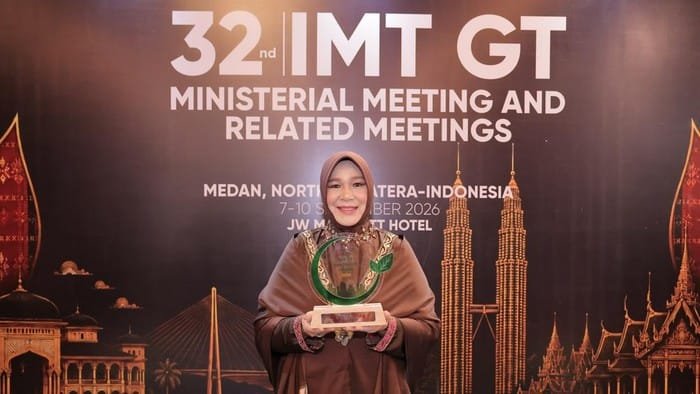
The recognition of Banda Aceh with a Silver Award in the Solid Waste Management category of the first IMT-GT Green City Award has placed municipal environmental policy within a broader regional conversation. Mayor Illiza Sa’aduddin Djamal received the award during the Gala Dinner of the 32nd IMT-GT Ministerial Meeting and Related Meetings in Medan on September 9, 2026. The award was presented by Malaysia’s Minister of Economy, Akmal Nasrullah bin Mohd Nasir.
The Solid Waste Management category recognised three cities: Manjung Municipality in Malaysia with a Gold Award, Banda Aceh City with a Silver Award, and Pekanbaru City with a Bronze Award. The distinction acknowledges Banda Aceh’s efforts in waste management and environmentally oriented urban development, while also providing a reference point for examining how local governments translate sustainability objectives into public policy.
Regional Cooperation Meets Municipal Responsibility
The IMT-GT Green City Award was established to recognise cities demonstrating sustained commitment, innovation and progress in greener, more inclusive and climate-resilient urban development. Its framework is aligned with the IMT-GT Vision 2036, the Sustainable Urban Development Framework, ASEAN sustainable urbanisation priorities and the United Nations Sustainable Development Goals.
This makes the award relevant beyond the question of which city receives a particular distinction. It creates a mechanism through which municipal initiatives can be assessed within a shared regional framework. For policymakers, that matters because environmental problems rarely stop at administrative boundaries. Waste, resource use, urban growth and climate resilience are increasingly interconnected policy concerns across Southeast Asian cities.
The award framework also requires submitted initiatives to have been implemented for at least three consecutive years, remain active and demonstrate measurable outcomes. Applications are assessed against criteria including impact, sustainability, innovation, scalability and adaptability, as well as governance and participation.
Such criteria place an emphasis on implementation rather than announcements alone. For local governments, the challenge is therefore not simply to formulate environmental programs, but to institutionalise them, measure their results and maintain public participation over time.
Waste Management as a Governance Issue
Banda Aceh Mayor Illiza Sa’aduddin Djamal has described the award as both recognition and motivation to continue improving environmental and waste-management performance. She has also stressed that waste management cannot be handled by government alone and requires participation from communities, businesses, organisations and other stakeholders.
That position points to a central issue in urban environmental governance. Waste management is not exclusively a technical service. It also involves citizen behaviour, private-sector participation, community organisations, infrastructure, enforcement, education and the consistency of public administration.
Illiza’s emphasis on “Banda Aceh Kolaborasi” similarly frames environmental management as a collective governance task. In this model, government retains an important coordinating and regulatory role, while residents, businesses and civil-society groups become part of implementation.
The policy challenge is making that collaboration operational. Participation needs to be translated into defined responsibilities, measurable programs and mechanisms through which local stakeholders can contribute to the city’s environmental objectives.
From Awards to Measurable Public Outcomes
The significance of the IMT-GT framework is also reflected in comments from Indonesian Home Affairs Minister Tito Karnavian during the ministerial meeting. Tito emphasised that IMT-GT should produce concrete and measurable programs and projects that provide direct benefits to communities, rather than functioning only as a forum for dialogue. He also encouraged stronger cooperation between Indonesia, Malaysia and Thailand through arrangements such as sister-city and sister-province partnerships.
For cities such as Banda Aceh, this creates an important policy connection between regional cooperation and local service delivery. A regional framework becomes meaningful when knowledge, partnerships and successful practices can be translated into programs that residents can experience in their daily lives.
The Green City Award’s emphasis on knowledge exchange and replication is particularly relevant in this regard. The official IMT-GT framework identifies city-to-city cooperation and the sharing of best practices as part of the award’s broader purpose. Recognised cities can also gain visibility through the IMT-GT network and its Green Cities Best Practice Platform.
A Policy Test for the Next Stage
For Banda Aceh, the Silver Award can therefore be viewed as a policy milestone rather than a final destination. The city government has publicly stated that the recognition should encourage further improvement in waste management. The next stage will involve maintaining existing efforts, identifying areas for improvement and ensuring that collaboration becomes a sustained part of urban governance.
There is also a wider regional lesson. Southeast Asian cities face different administrative structures and local conditions, but many confront similar questions about how to manage waste, maintain environmental quality and involve citizens in sustainability programs.
The value of regional platforms such as IMT-GT lies partly in their ability to allow these cities to compare experiences without assuming that a single model can be applied everywhere. Solutions can be adapted according to local institutional capacity, geography, infrastructure and community participation.
Banda Aceh’s recognition consequently offers a useful example of how a regional sustainability framework can connect with municipal policy. Its longer-term significance will depend on whether the recognition contributes to stronger implementation, measurable environmental outcomes and deeper cooperation between government and society.
As the IMT-GT Green City Award develops, the experience of participating cities may increasingly become part of a wider policy conversation about sustainable urbanisation in Southeast Asia. For Banda Aceh, the immediate award provides recognition; the continuing policy work will determine how that recognition translates into lasting public value.