
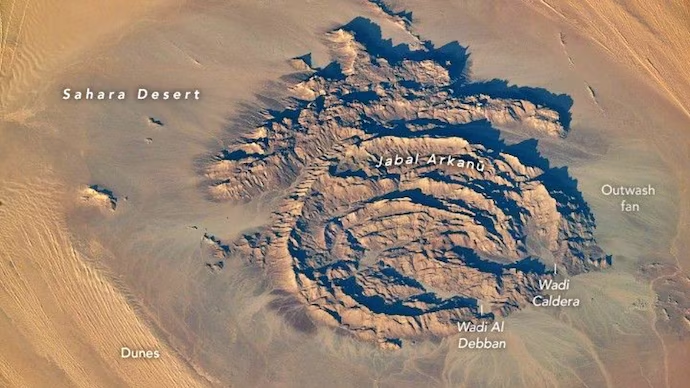
Sahara Desert — An astronaut’s photograph of concentric rings of rock in the middle of the Sahara has reignited global curiosity. Known as the Richat Structure or “Eye of the Sahara,” this geological formation has long fascinated scientists, historians, and explorers. Its striking circular patterns, visible from space, blur the line between natural wonder and cultural myth.
From a regional‑global analysis perspective, the image is more than a scientific curiosity. It highlights Africa’s role in shaping global narratives of geology, exploration, and heritage. The Sahara, often perceived as a barren expanse, emerges here as a stage for planetary storytelling — a reminder that landscapes carry both scientific data and symbolic meaning.
Observers note that the Richat Structure is believed to have formed through erosion and uplift, not meteor impact as once speculated. Yet its resemblance to a giant eye continues to inspire myths, linking it to Atlantis or ancient civilizations. This duality — science and legend — underscores how natural formations can transcend their physical origins to become cultural icons.
The editorial narrative emphasizes that astronaut imagery plays a crucial role in reframing regional phenomena for global audiences. A single photograph from orbit transforms a remote desert feature into a shared point of wonder, bridging continents and disciplines.
Furthermore, the rings of rock remind us of the interconnectedness of Earth’s geology. Similar structures exist elsewhere, but the Sahara’s “Eye” is unique in scale and visibility. Its prominence in space photography ensures that Africa’s landscapes remain central to global scientific and cultural discourse.
Ultimately, the astronaut’s capture of the Sahara rings is not just a visual spectacle. It is a global narrative — showing how regional landscapes can embody universal questions about origin, identity, and the human impulse to find meaning in nature.