


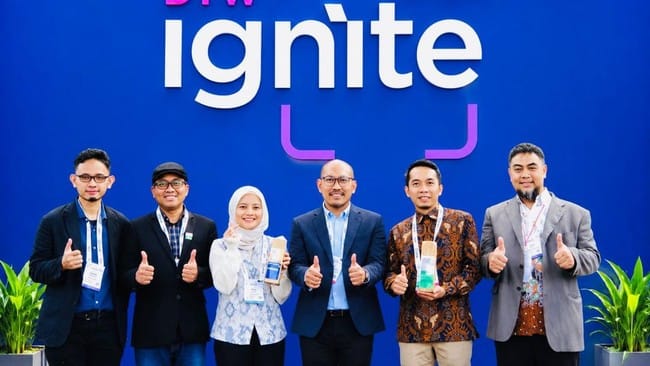
Telkomsel’s three global recognitions at TM Forum DTW Ignite 2026 highlight how AI, autonomous networks and resilient connectivity are shaping Southeast Asia’s digital policy landscape.
JAKARTA — The evolution of telecommunications is increasingly becoming a matter of public policy as much as a matter of technology. As societies become more dependent on digital connectivity, the reliability of telecommunications networks has implications for economic activity, public services, emergency response and social resilience.
Against this backdrop, Telkomsel’s three global recognitions at TM Forum Digital Transformation World (DTW) Ignite 2026 offer an interesting case study of how a major Southeast Asian operator is approaching the next stage of digital infrastructure.
Held in Copenhagen, Denmark, on 23–25 June 2026, DTW Ignite brought together more than 5,000 industry participants from more than 100 countries. Telkomsel received recognition for its AI-powered early-warning system, its contribution to TM Forum Catalyst and its progress toward Autonomous Network Level 4 (ANL-4).
While the awards themselves are corporate achievements, the underlying technologies raise broader questions about how governments, regulators and industry should approach the future of digital infrastructure.
AI and the Changing Definition of Network Resilience
Telkomsel’s AI-Powered Early Warning System was recognised through the TM Forum Excellence Awards 2026 in the Excellence in People, Profit, and Planet category.
The system is designed to identify potential impacts from disasters at an earlier stage, enabling the company to accelerate its response and maintain service continuity. Telkomsel says the system integrates internal and external data and has detected thousands of incidents, reached hundreds of cities and delivered millions of alerts.
From a public-policy perspective, this development is significant because telecommunications networks increasingly function as essential infrastructure.
During disasters, connectivity can support emergency communications, dissemination of public information, coordination among authorities and continuity of economic activity.
The question of network resilience therefore extends beyond whether an operator can restore service after an outage. It increasingly concerns whether infrastructure can anticipate disruption and respond before the consequences become more severe.
From Commercial Networks to Strategic Infrastructure
For many years, telecommunications policy focused primarily on expanding coverage, encouraging competition and improving affordability.
Those objectives remain essential.
However, the growing digitisation of public and private services is creating another policy priority: resilience.
Banking, logistics, healthcare, education, public administration and commerce increasingly rely on connectivity. A prolonged disruption can consequently affect several sectors simultaneously.
This makes investments in predictive network management and disaster preparedness relevant to national resilience strategies.
Telkomsel’s early-warning initiative illustrates how a commercial operator can use AI to support a function with wider social implications.
The Autonomous Network Question
Telkomsel’s second major technology milestone is its ANL-4 Alpha Validation from TM Forum.
The company states that it is the first operator in Indonesia and the third in Southeast Asia to achieve this validation. Its implementation uses AI for service-quality management through the NPS Improvement with AI for Autonomous by TAZ solution.
Autonomous networks represent a major change in the relationship between humans and telecommunications infrastructure.
Instead of relying exclusively on human teams to monitor network conditions and respond to problems, increasingly autonomous systems can analyse information and undertake defined actions with progressively less manual intervention.
TM Forum has been developing frameworks and methodologies for autonomous networks, including measures for effectiveness and maturity. Telkomsel has also been involved in the organisation’s autonomous-network work for several years.
Why Regulators Should Pay Attention
The transition toward autonomous networks creates several regulatory questions.
First is accountability.
If an AI-driven system automatically changes network parameters or initiates corrective actions, regulators and operators need clear mechanisms for determining responsibility when something goes wrong.
Second is cybersecurity.
Greater automation could potentially improve resilience, but it also creates new attack surfaces. An AI-enabled network must be protected against malicious manipulation, corrupted data and unauthorised actions.
Third is transparency.
As decision-making becomes increasingly automated, operators need governance structures capable of explaining how critical decisions are made and ensuring that human intervention remains possible when necessary.
These considerations will become increasingly relevant as autonomous systems move from isolated use cases toward broader network operations.
Data as a Policy Issue
The development of AI-driven telecommunications also makes data governance more important.
Telkomsel IT Director Joyce Shia has emphasised that AI can generate meaningful impact when supported by integrated and trusted data and systems. She also highlighted responsible AI as part of the company’s effort to improve customer experience and support more inclusive and sustainable digital development.
This is not simply an internal technology issue.
Data quality, interoperability, privacy and cybersecurity are increasingly becoming matters of national digital policy.
For Southeast Asian governments, the challenge is to create regulatory environments that encourage responsible innovation without creating unnecessary barriers to technological development.
Southeast Asia’s Different Starting Points
The policy challenge becomes more complex when viewed across Southeast Asia.
ASEAN countries differ substantially in terms of digital infrastructure, regulatory maturity, geographic conditions and levels of digital adoption.
Some markets are highly urbanised and densely connected, while others must address significant rural and remote connectivity gaps.
Indonesia presents an especially distinctive case because its telecommunications infrastructure must serve a vast archipelago.
The development of autonomous and AI-driven network capabilities may therefore provide operational advantages, but it cannot replace the need for continued investment in physical infrastructure and equitable access.
Digital intelligence and digital inclusion must develop together.
Collaboration as a Governance Mechanism
Telkomsel’s Catalyst Innovator Recognition with a “Visionary” distinction also illustrates why cross-industry collaboration is becoming increasingly important.
The TM Forum Catalyst programme brings together communications service providers, technology companies and other organisations to develop practical solutions to industry challenges.
In 2026, 59 Catalyst teams co-created solutions that were showcased at DTW Ignite.
Such collaboration can also have policy implications.
Technology standards developed through international industry cooperation can influence how operators deploy systems across borders.
For ASEAN, greater interoperability could support a more connected regional digital economy.
The Role of Industry Standards
Telecommunications has historically depended on standards to ensure that systems from different vendors and operators can work together.
AI and autonomous networks make that requirement even more important.
If AI-driven systems operate according to incompatible architectures, the industry could face fragmentation.
TM Forum’s autonomous-network initiatives are designed partly to address this challenge by developing frameworks, methodologies and common approaches for measuring and advancing network autonomy.
For policymakers, industry standards can provide a useful complement to regulation.
Rather than attempting to prescribe every technological detail, regulators can establish broad requirements around safety, security, accountability and interoperability while allowing technical standards to evolve through industry collaboration.
Digital Resilience and Disaster Management
Indonesia’s geographic and environmental conditions make the connection between telecommunications and disaster management particularly important.
An early-warning system integrated into a telecommunications operator’s operations can provide value at multiple levels.
At the company level, it can support business continuity.
At the customer level, it can help maintain connectivity.
At the broader societal level, it can contribute to faster communication during emergencies.
This creates an opportunity for closer coordination between telecommunications operators and public authorities.
Public agencies hold important information about weather, disasters and emergency situations, while operators possess extensive infrastructure and connectivity capabilities.
Responsible data-sharing mechanisms could potentially strengthen early-warning and response systems while preserving appropriate privacy and security safeguards.
AI Should Complement, Not Replace, Public Policy
There is a temptation to view technological innovation as a substitute for policy intervention.
It is not.
AI can improve prediction and operational response, but resilient digital infrastructure also requires clear rules, investment, skilled personnel, redundancy, cybersecurity and coordination among stakeholders.
Telkomsel’s experience demonstrates what technology can accomplish within an operator’s network, but the wider resilience of a country’s digital infrastructure depends on the broader ecosystem.
This distinction is important as governments increasingly consider AI as a tool for national development.
Technology can strengthen policy implementation, but it does not remove the need for sound policy.
The Human Dimension of Autonomous Infrastructure
Greater automation also changes the skills required in telecommunications.
TM Forum’s work on autonomous networks has highlighted talent and organisational transformation as important elements in reaching higher levels of network autonomy. Earlier TM Forum reporting on Telkomsel’s autonomous-network journey identified talent and the availability of people capable of implementing automation as a major challenge.
This suggests that policymakers and industry leaders should think about workforce development alongside technology deployment.
Engineers will increasingly need expertise in AI, data, automation, cybersecurity and system integration.
Universities and vocational institutions can play an important role in developing those skills.
Without sufficient talent, investments in advanced infrastructure may not deliver their full potential.
The Risk of a Digital Divide in AI
Another policy consideration is whether the benefits of AI-enabled telecommunications will be distributed evenly.
Large operators with substantial resources may be able to invest in advanced automation more quickly than smaller providers.
If the technological gap becomes too wide, differences in service quality could emerge between markets and regions.
Governments therefore need to consider how innovation policies can support both advanced infrastructure and inclusive access.
For ASEAN, this issue is particularly important because the region’s digital economies are developing at different speeds.
Telkomsel’s Position in the Regional Landscape
Telkomsel’s ANL-4 validation places the company among the early operators in Southeast Asia to achieve a high level of autonomous-network validation.
The company says its status as the first Indonesian and third Southeast Asian operator to obtain the validation demonstrates the progress of its network transformation.
However, the more important regional question is whether such capabilities can contribute to a broader improvement in digital infrastructure.
A technologically advanced operator can become a reference point for the market, encouraging other players to adopt more sophisticated approaches to automation, resilience and service assurance.
That could ultimately raise the region’s overall digital infrastructure standards.
Policy Implications for ASEAN
Several policy priorities emerge from this development.
First, governments need to support reliable and resilient digital infrastructure as a component of economic security.
Second, regulatory frameworks for AI should address accountability, cybersecurity and data governance without unnecessarily restricting innovation.
Third, industry standards and interoperability should be encouraged as autonomous systems become more widespread.
Fourth, workforce development needs to keep pace with the increasing sophistication of telecommunications technology.
Finally, public-private cooperation should be strengthened, particularly in areas involving disaster preparedness and critical connectivity.
These priorities are not unique to Indonesia.
They are increasingly relevant across ASEAN.
The Broader Digital Economy
The significance of intelligent telecommunications extends beyond mobile connectivity.
As businesses adopt cloud computing, AI applications, Internet of Things technologies and increasingly distributed digital services, the network becomes an essential part of the digital production system.
An unreliable network can become a constraint on economic growth.
A more intelligent and resilient network, by contrast, can support more predictable digital operations.
This is why developments in telecommunications should increasingly be viewed through the lens of economic policy.
From Recognition to Public Value
Telkomsel’s three recognitions provide a useful example of how corporate innovation can intersect with public priorities.
The AI-powered early-warning system relates directly to resilience.
Autonomous networks relate to service reliability and operational efficiency.
Catalyst participation relates to innovation ecosystems and standards.
The challenge now is to ensure that technological advances generate measurable public and economic value.
Recognition provides external validation, but long-term impact will depend on how consistently these technologies are deployed and how effectively they improve network performance.
What Comes Next
The next phase of telecommunications transformation will likely involve deeper integration between AI, network automation, cloud infrastructure and data platforms.
The distinction between a telecommunications company and a broader digital infrastructure provider may consequently become less pronounced.
For policymakers, this means traditional telecommunications regulation may increasingly intersect with AI governance, cybersecurity, cloud policy and digital economy strategy.
For operators, it means technological capability will need to be matched by strong governance and responsible implementation.
Conclusion
Telkomsel’s three global recognitions at TM Forum DTW Ignite 2026 provide a window into the changing role of telecommunications in Southeast Asia.
The company’s AI-powered early-warning system demonstrates how network technology can contribute to resilience. Its autonomous-network validation illustrates the shift toward increasingly intelligent infrastructure. Its participation in TM Forum Catalyst demonstrates the importance of collaboration in developing new industry capabilities.
For Indonesia and ASEAN, the lesson extends beyond technology.
The future of digital infrastructure will depend on the ability of governments, regulators, operators and technology companies to work together around common principles of resilience, security, interoperability and inclusion.
As connectivity becomes increasingly essential to modern life, the question is no longer simply how fast networks can become.
It is how intelligently, securely and equitably they can serve society.
Sources
CNN Indonesia — Telkomsel Raih Tiga Pengakuan Global di TM Forum DTW Ignite 2026