


Griselda Nuria Alisha’s DJOGOSURO project highlights how local heritage, digital learning and youth innovation can support disaster preparedness in Southeast Asia.
An Indonesian student’s award-winning project in Malaysia is drawing attention to an approach that connects local cultural knowledge, digital technology and disaster preparedness. The project, developed by Griselda Nuria Alisha of MAN 1 Kota Malang, uses the story of Lembu Suro as a foundation for educating young people about volcanic-eruption preparedness.
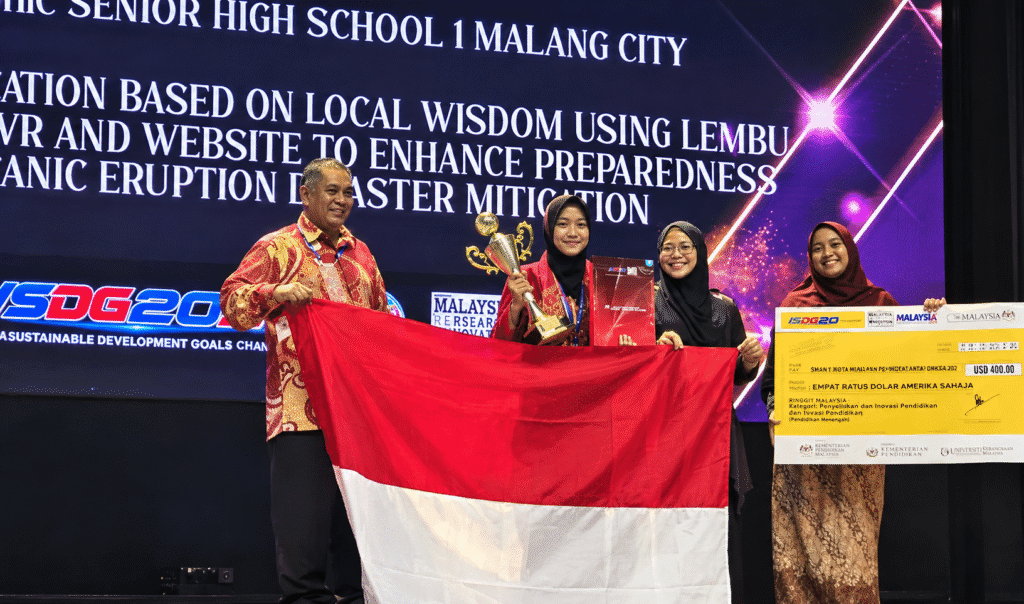
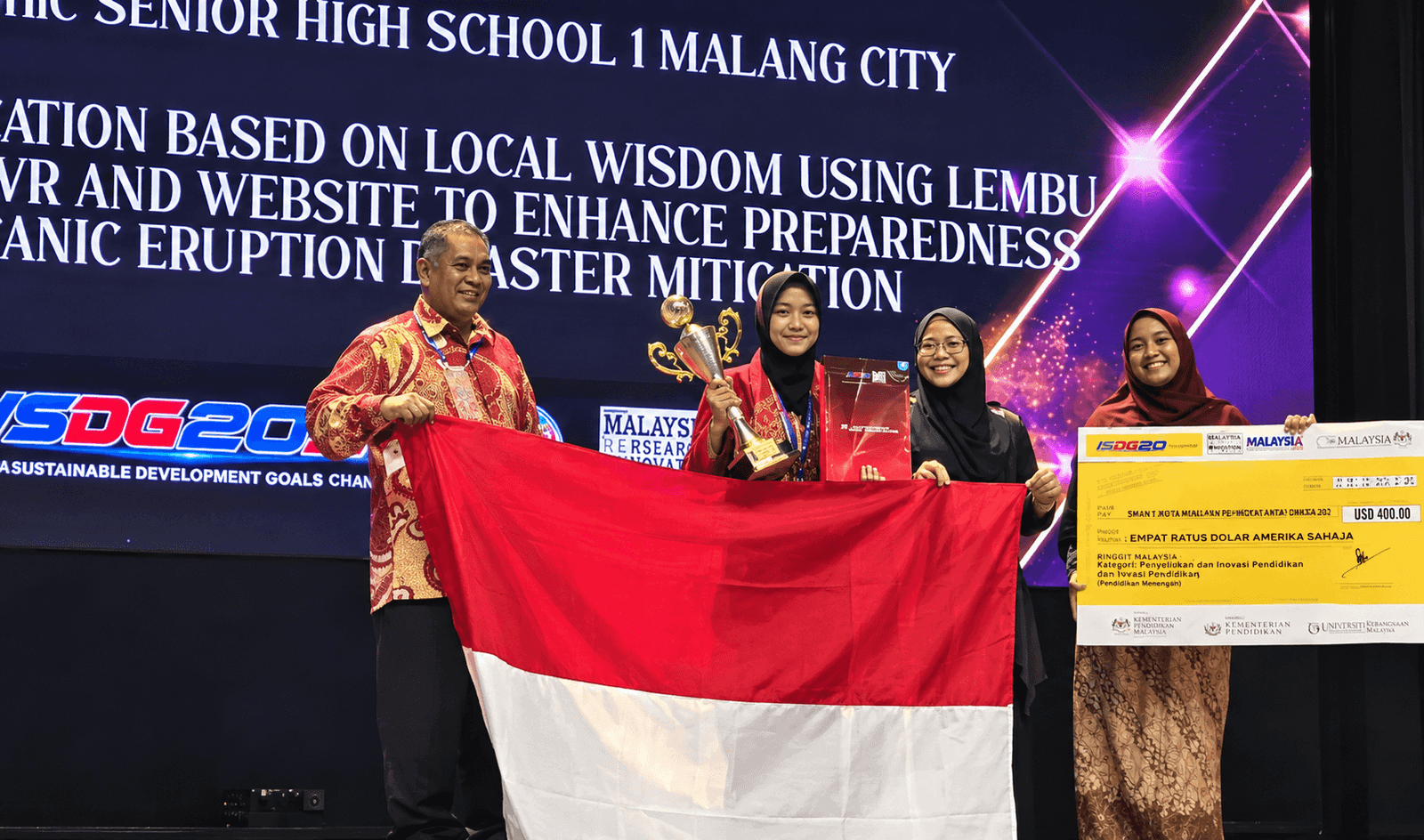
Griselda received the MMU President’s Excellence Award – 2nd Runner-Up at the World Sustainable Development Goals Challenge (WSDG) 2026 in Cyberjaya, Malaysia. Her project, titled “DJOGOSURO: Education Based on Local Wisdom Using Lembu Suro Cinematic VR and Website to Enhance Preparedness for Volcanic Eruption Disaster Mitigation,” was presented as an individual entry representing her school.
The achievement comes at a time when governments and educational institutions across Southeast Asia are increasingly examining how young people can contribute to sustainable development and community resilience. At the WSDG 2026 event, the United Nations Resident Coordinator in Malaysia, Singapore and Brunei Darussalam emphasized that innovation should connect ideas developed in classrooms with practical solutions for communities.
Local Knowledge as a Policy Resource
DJOGOSURO is built around Lembu Suro, a cultural narrative associated with communities around Mount Kelud in East Java. Rather than treating cultural heritage solely as a historical subject, the project uses it as an entry point for communicating information about volcanic hazards.
This approach raises an important question for education and public policy: how can disaster preparedness messages become more relevant to the communities expected to use them?
Technical information remains essential, but communication is also a key component of preparedness. Local stories, symbols and knowledge can provide a familiar context through which students begin to understand risk.
In this sense, DJOGOSURO represents a localized approach to a broader public-policy challenge. It does not attempt to replace official disaster-management information. Instead, its concept is to create an educational bridge between formal knowledge and the cultural environment in which students live.
The project combines Cinematic Virtual Reality and a website to present educational material concerning volcanic eruptions. The original TIMES Indonesia report notes that the concept is intended to help users understand mitigation and preparedness through digital media.
Why Disaster Education Matters
Indonesia’s geographical position makes disaster preparedness an important part of public education. Volcanic activity is one of the risks faced by communities living around the country’s active volcanoes, including communities in the wider Mount Kelud region.
The Malang Regency government has also been strengthening disaster preparedness within educational environments. In May 2026, the Malang Regency Regional Disaster Management Agency participated in a workshop on the Safe School for Disaster (Satuan Pendidikan Aman Bencana/SPAB) programme, reflecting efforts to strengthen community-based disaster mitigation in schools.
This institutional context is relevant to projects such as DJOGOSURO. Educational technology can potentially complement existing preparedness programmes by providing additional ways for students to encounter and revisit disaster-related information.
However, the distinction between an educational concept and a proven intervention remains important. The available reporting on DJOGOSURO documents its development and recognition in the WSDG competition, but does not provide a measured assessment of whether the platform has produced a quantifiable increase in community preparedness.
That distinction matters for future development. If the project is expanded, evaluation could help determine which features are most effective and how the platform can complement existing disaster-education policies.
Youth and Sustainable Development
Griselda’s participation also reflects a broader role for young people in sustainable-development initiatives. The United Nations’ message at WSDG 2026 stressed that young innovators should not simply wait until they graduate or enter professional careers before contributing to solutions.
This perspective is particularly relevant to Southeast Asia, where the region’s future challenges will require participation from multiple generations. Climate change, disaster resilience, education, food security and responsible technology use cannot be addressed solely through government programmes.
Student competitions can provide one mechanism for exposing young people to these challenges. They create opportunities to research problems, develop prototypes, communicate ideas and interact with participants from different countries.
Griselda’s own experience includes both innovation and school leadership. She previously served as Chair of the MAN 1 Kota Malang student council for the 2025/2026 period. Her participation in WSDG 2026 therefore represents an extension of an educational journey that includes organizational responsibility as well as project development.
Regional Cooperation Through Education
The Malaysia setting also gives the project a wider regional dimension. Indonesia and Malaysia have long-standing educational, cultural and people-to-people connections. International student programmes and academic exchanges provide opportunities for ideas developed in one country to be introduced to audiences elsewhere.
A recent example reported by TIMES Indonesia involved an Indonesia–Malaysia education benchmarking initiative involving Universitas Ahmad Dahlan, Universitas Muhammadiyah Semarang and International Islamic School Malaysia. The programme focused on exchanging educational experiences and developing opportunities for cross-border cooperation.
Against this backdrop, student innovation competitions can function as informal spaces for regional knowledge exchange. A project such as DJOGOSURO does not need to be replicated exactly in another country to become relevant. Its underlying methodology—connecting local knowledge with digital education—could potentially be adapted to different cultural and environmental contexts.
For example, communities in other parts of Southeast Asia facing floods, landslides, earthquakes or volcanic hazards could explore their own cultural knowledge as part of locally appropriate educational materials.
From Award to Public Value
Griselda received her award during the WSDG 2026 International Awarding Ceremony on September 26 at Tun Chancellor Hall, Multimedia University. Along with the recognition, she received a trophy, medal and RM850 prize.
Yet the longer-term value of DJOGOSURO will depend on what happens after the competition. International recognition can provide visibility, but continued testing, evaluation and collaboration would be necessary if the project is to develop into a broader educational resource.
Possible next steps could include expanding the content to other schools, developing additional learning scenarios, improving accessibility and working with education and disaster-management authorities.
Such cooperation could also help establish clearer indicators of impact. Student engagement, knowledge retention, understanding of evacuation procedures and changes in preparedness awareness are among the areas that could be evaluated if the project enters a broader implementation phase.
A Broader Lesson for Southeast Asia
The significance of DJOGOSURO ultimately extends beyond the award itself. It illustrates how a young person can begin with an issue that is highly local and then present it within an international sustainability forum.
It also demonstrates that cultural heritage and technological innovation do not necessarily represent opposing directions. Local knowledge can provide context, while technology can provide new ways to communicate and teach.
For policymakers and educators, the case offers a point for further discussion: how can schools become places where students not only learn about public challenges but also develop and test ideas for addressing them?
The answer will vary across countries and communities. But the experience of DJOGOSURO suggests that locally grounded education can have regional relevance when it is combined with research, technology and opportunities for international exchange.
From Malang to Cyberjaya, Griselda’s project has opened a small but meaningful window into what youth-led innovation can look like in Southeast Asia. Its next chapter will be determined not by the award alone, but by whether the idea can continue to evolve, be evaluated and contribute to practical disaster-preparedness education.