



Plaza Seremoni’s MLAA 2026 recognition highlights Nusantara’s approach to public-space planning, sustainability, and long-term urban policy.
NUSANTARA — The development of Indonesia’s Nusantara is increasingly becoming a case study in how a new capital can combine administrative functions with public life and environmental considerations. The recognition of Plaza Seremoni at the Malaysia Landscape Architecture Awards (MLAA) 2026 provides another perspective on the policy choices shaping the new capital.
Plaza Seremoni received an Honour Award in the Landscape Design Award, Professional Category, at MLAA 2026. The official awards list places the Nusantara project among international landscape projects recognized alongside projects from Singapore, Thailand and the Netherlands.
The recognition is relevant beyond the field of landscape architecture because the design of public spaces increasingly intersects with public policy. Decisions about pedestrian access, green areas, water management, public facilities and community use can influence how an urban district functions and how residents experience government-led development.
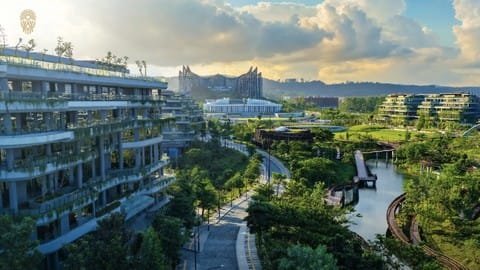
Plaza Seremoni is located in front of the State Palace and Garuda Palace and forms part of the Sumbu Kebangsaan area. According to the Nusantara Capital Authority, the area is intended to function as a center for state activities while also providing a space for public interaction.
This dual function reflects an important policy question for new capitals: how can spaces associated with the state remain accessible and relevant to ordinary urban life? Plaza Seremoni was designed with an open-air amphitheatre, pedestrian and cycling paths, green areas, an MSME gallery and communal spaces, giving the area functions beyond ceremonial activities.
The approach also reflects a broader shift in urban policy across Asia. New developments are increasingly expected to integrate environmental considerations into infrastructure planning rather than treating sustainability as an additional feature after construction decisions have already been made.
In Nusantara, the landscape design takes into account the natural contours of the land and existing water-management systems. The OIKN describes this approach as part of an effort to maintain environmental balance and strengthen the identity of Nusantara as a city that grows in harmony with nature.
Basuki Hadimuljono, Head of the Nusantara Capital Authority, has summarized the development principles in three areas: quality, aesthetics and sustainability. These principles provide a framework for understanding how the authority seeks to balance physical development with the longer-term character of the city.
The policy dimension becomes particularly important because Nusantara is being developed not simply as another urban district, but as Indonesia’s future political capital. The OIKN has linked the development of the city to preparations for its role as a political capital in 2028, as stipulated in Presidential Regulation No. 79 of 2025.
That transition places additional importance on the quality and functionality of public spaces. A capital must accommodate formal governmental activities, but it also needs places where citizens can interact, conduct economic activities, participate in cultural events and experience the city as a shared public environment.
The Plaza Seremoni model is therefore relevant to the wider Asian debate over capital-city development. From Putrajaya to other planned urban districts across the region, governments have experimented with purpose-built administrative environments. The continuing policy challenge is ensuring that planned districts do not become isolated government enclaves, but develop into functioning urban communities.
For Nusantara, this means that recognition for design is only one stage in a longer process. The effectiveness of public policy will ultimately depend on how these spaces are operated, maintained and connected with the wider urban system as the population and economic activity of the capital grow.
The international recognition of Plaza Seremoni nonetheless provides a useful signal about the direction of the project. Its combination of ceremonial, social and ecological functions demonstrates how landscape architecture can become part of broader public policy rather than remaining an aesthetic consideration.
As Nusantara continues to develop, its experience may offer lessons for other Asian governments considering new administrative districts, planned cities or major urban transformations. The central question will not only be how a new city looks, but whether its physical design supports the social, environmental and institutional objectives established by public policy.
In that sense, Plaza Seremoni represents a relatively small component of a much larger national project. Yet the way such a space is designed illustrates the practical choices through which a vision for a future capital is translated into the everyday urban environment.