


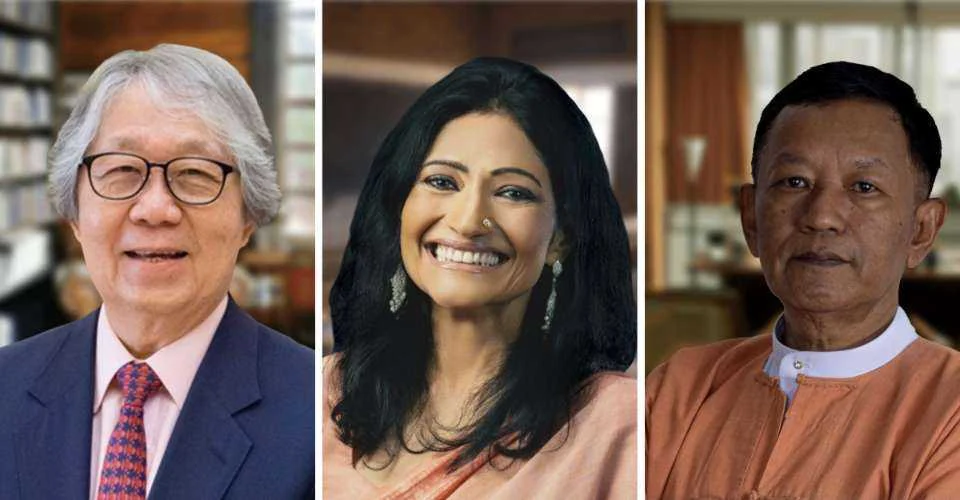
Tommy Koh, Runa Khan and Bo Kyi receive the 2026 Ramon Magsaysay Award, highlighting the role of diplomacy, humanitarian innovation and human rights in shaping Asia’s future.
The 2026 Ramon Magsaysay Award has brought renewed attention to three forms of leadership that are increasingly relevant to Asia’s evolving political and social landscape. Singaporean diplomat and legal scholar Tommy Koh, Bangladeshi humanitarian Runa Khan, and Myanmar human rights advocate Bo Kyi have been selected as this year’s recipients for their respective contributions to diplomacy, community development and the protection of human rights.
The award, widely regarded as one of Asia’s leading recognitions for public service, emphasizes leadership grounded in service to others rather than institutional position alone. Since its establishment in 1957, it has recognized individuals and organizations whose work demonstrates what the Ramon Magsaysay Award Foundation describes as “greatness of spirit.” The 2026 recipients add three distinct perspectives to that tradition.
Diplomacy and the Architecture of Regional Cooperation
Tommy Koh’s selection underscores the continuing importance of international law and diplomacy at a time when strategic competition is reshaping relations across the Indo-Pacific. Over a career spanning more than five decades, Koh has played prominent roles in international negotiations, most notably as president of the Third United Nations Conference on the Law of the Sea, which contributed to the development of UNCLOS.
His career offers an important policy lesson for the region. International agreements often require years of negotiation, compromise and confidence-building before producing results. In an Asia increasingly characterized by maritime disputes, economic interdependence and competing strategic interests, the institutions created through diplomacy remain critical mechanisms for managing differences peacefully.
Koh’s experience also extends into ASEAN-related institution building. He chaired the High-Level Task Force responsible for drafting the ASEAN Charter in 2007, demonstrating how diplomacy can operate not only at the global level but also within regional institutions.
Humanitarian Policy in an Era of Climate Pressure
Runa Khan’s recognition highlights a different policy challenge: how to deliver essential services to populations living in geographically isolated and environmentally vulnerable areas. Through Friendship, the organization she founded in Bangladesh, Khan has worked to expand access to healthcare, education, livelihoods and other services for communities affected by river erosion, flooding and climate-related displacement.
Her work reflects a broader shift in humanitarian policy. Climate change is increasingly forcing governments and development organizations to reconsider traditional assumptions about infrastructure and service delivery. Communities can move, land can disappear and access routes can change rapidly. As a result, flexible and mobile approaches may become increasingly important across climate-vulnerable parts of Asia.
For policymakers, Khan’s experience illustrates the value of combining humanitarian assistance with local knowledge. Instead of treating vulnerable populations solely as recipients of aid, development programs can be designed around their ability to adapt, participate and rebuild livelihoods.
Human Rights and Civic Resilience
Bo Kyi’s recognition places human rights and civic resilience at the center of the 2026 award. A former political prisoner, Bo Kyi co-founded the Assistance Association for Political Prisoners (AAPP) in 2000. The organization has documented political arrests and supported prisoners and their families.
The relevance of that work has intensified following Myanmar’s military coup in 2021. The continuing political crisis has generated extensive concerns regarding arbitrary detention, political imprisonment and violence. In this environment, documentation becomes more than an archival exercise: it can provide evidence, support families and preserve information about events that might otherwise remain difficult to verify.
From a regional policy perspective, Bo Kyi’s work raises questions about the relationship between governance, accountability and civil society. It demonstrates how non-governmental organizations can become important actors in documenting social conditions and advocating for affected communities, particularly when formal institutions are unable or unwilling to provide adequate mechanisms for redress.
Three Different Paths Toward Public Impact
The three laureates operate in very different environments, yet their work reveals a common principle. Effective leadership can emerge through international institutions, humanitarian organizations or civil society networks. What connects them is a sustained commitment to addressing problems that extend beyond individual interests.
Their selection also reflects some of the defining policy challenges facing contemporary Asia. Maritime and geopolitical tensions require diplomacy and rules-based cooperation. Climate vulnerability demands new approaches to humanitarian assistance and development. Political crises require mechanisms for protecting human dignity and documenting violations.
These challenges are unlikely to be resolved by governments alone. Businesses, universities, humanitarian organizations and civil society groups increasingly have roles to play. The stories of Koh, Khan and Bo Kyi demonstrate how leadership outside conventional political structures can complement public institutions and influence wider policy discussions.
Implications for Asia’s Future
The 2026 Ramon Magsaysay Award therefore carries significance beyond the recognition of three individuals. It provides a snapshot of the kinds of leadership that Asia may increasingly need: diplomatic leadership capable of building consensus, humanitarian leadership capable of adapting to climate realities, and civic leadership capable of defending human rights.
The formal award ceremony is scheduled for November 15, 2026, at the Metropolitan Theatre in Manila. The occasion will provide an opportunity not only to honor the three recipients but also to place their experiences within a broader regional conversation about service, resilience and responsible leadership.
As Asia continues to navigate geopolitical competition, environmental disruption and social inequality, the experiences of these three laureates offer different but complementary approaches. Their recognition suggests that the region’s future will depend not only on economic growth or political power, but also on the institutions, communities and individuals willing to turn principles into sustained action.