



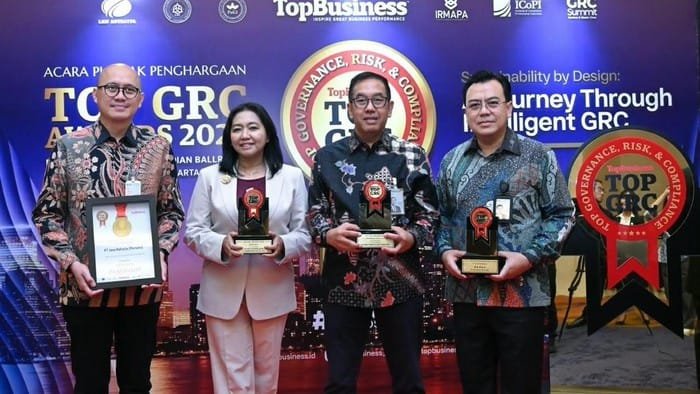
Jasa Raharja’s four TOP GRC Awards 2026 highlight how governance, risk management and compliance are becoming increasingly important to Indonesia’s public-service institutions.
JAKARTA — Governance, risk management and compliance are increasingly being viewed as essential components of institutional resilience in Indonesia’s financial and public-service sectors. The latest recognition received by PT Jasa Raharja (Persero) provides one example of how these principles are being incorporated into the management of an organisation with a public-protection mandate.
At the TOP GRC Awards 2026, Jasa Raharja received four recognitions: the Platinum Medal, TOP GRC Awards 2026 #Star 5, The High Performing Board of Commissioners on GRC 2026, and The Most Committed GRC Leader 2026 for President Director Muhammad Awaluddin. The awards were presented at Raffles Jakarta on September 9, 2026.
The recognition comes amid broader efforts by Indonesian regulators to strengthen governance and risk-based supervision across the financial-services sector. In April 2026, the Financial Services Authority (OJK) said it was strengthening governance, prudential requirements and risk-based supervision in the insurance, guarantee and pension-fund sectors.

For Jasa Raharja, this regulatory environment provides an important institutional context. The company operates in the social insurance sector and is responsible for passenger accident insurance and third-party liability protection related to road traffic accidents. Its governance framework therefore has implications not only for internal corporate management but also for the delivery of public protection services.
Governance as Part of Public-Service Capacity
Jasa Raharja President Director Muhammad Awaluddin has said that GRC should not be understood simply as a matter of fulfilling regulations. The company aims to integrate governance, risk management and compliance into business processes, decision-making and daily operations, while linking them to improvements in public services.
That perspective is consistent with a wider policy discussion about the role of governance in strengthening institutional capacity. In July 2026, OJK stated that strong governance, risk management and integrity are foundations for building a financial-services sector that is resilient, adaptive and competitive, while supporting sustainable economic growth.
The policy relevance extends beyond financial stability. For public-service institutions, governance also concerns accountability, consistency of service delivery, responsible use of resources and the ability to manage operational risks. These factors become particularly important when an organisation handles large numbers of public interactions and operates within a complex regulatory environment.
Jasa Raharja’s own governance framework is based on a combination of national regulations, BUMN governance requirements and OJK regulations applicable to insurance companies. The company states that its corporate governance guidelines include provisions covering good corporate governance, whistleblowing, conflict of interest, gratification control, information control, board governance and other governance mechanisms.
Risk Management in a Changing Environment
Risk management has also become increasingly important as public-service delivery becomes more digital and interconnected. Jasa Raharja states that its risk-management system follows ISO 31000:2018, with responsibility placed under its Directorate of Compliance and Risk Management. The company has also used a Risk Management Information System since 2012 and enhanced the application in 2023.
This infrastructure matters because the risk profile of modern organisations is no longer limited to traditional operational concerns. Technology, cybersecurity, data protection, regulatory changes and changing public expectations can all affect organisational resilience.
Jasa Raharja has consequently been exploring a more data-driven approach to risk management. During its Risk Townhall 2026, the company discussed moving from a risk-management approach focused primarily on identification, mitigation and reporting toward Risk Intelligence, with capabilities including early warning, predictive analytics, risk insights and decision support for management.
Such an approach reflects a broader shift in governance practice. Risk management increasingly seeks to provide forward-looking information rather than functioning solely as a control mechanism after a potential problem has emerged.
Digitalisation and Accountability
The digital transformation of public services adds another layer to the governance discussion. Technology can improve speed, accessibility and integration, but it also creates new requirements for data governance, cybersecurity, accountability and oversight.
For an institution involved in public protection, these considerations are particularly relevant. The objective of digitalisation is not simply to make processes faster, but to ensure that improvements in efficiency remain consistent with legal requirements, information security and the rights of stakeholders.
Jasa Raharja’s recent GRC initiatives therefore sit at the intersection of corporate governance and public policy. The company is simultaneously responding to regulatory expectations, operational risks, technological developments and the need to maintain accessible services.
Recognition and Institutional Continuity
The four TOP GRC Awards 2026 also form part of a longer record of GRC implementation. Jasa Raharja has maintained the five-star TOP GRC recognition for eight consecutive years, from 2019 to 2026, while its High Performing Board of Commissioners on GRC recognition has continued for six consecutive years, from 2021 to 2026.
From a policy perspective, continuity is relevant because governance systems need to function beyond individual programmes or annual recognition cycles. Their effectiveness depends on whether policies are consistently implemented throughout the organisation and adapted when regulations, technologies and risks change.
Awaluddin has also described the company’s GRC achievements as a collective effort involving the Board of Directors, Board of Commissioners and employees across the organisation. The emphasis on organisational participation suggests that governance is being approached as a shared responsibility rather than the task of a single compliance function.
A Wider Governance Conversation
Indonesia’s evolving governance framework places greater emphasis on resilience, risk-based supervision and sustainable institutional performance. OJK’s 2026 policy initiatives illustrate this broader direction within the financial-services sector.
Jasa Raharja’s experience offers a practical example of how these principles can be incorporated within a public-protection institution. Its GRC framework combines formal governance requirements with risk management, organisational culture and technology-supported processes.
The significance of the TOP GRC Awards recognition, therefore, extends beyond the ceremony itself. It provides an opportunity to examine how corporate governance is being connected with institutional resilience and public-service responsibilities.
The longer-term question is how effectively these frameworks continue to translate into operational decisions and services. Recognition can document an organisation’s progress at a particular point in time, while sustainable governance requires continuous implementation, monitoring and adjustment.
For Jasa Raharja, the latest awards mark another stage in that continuing process. As Indonesia’s regulatory and digital environment evolves, the integration of governance, risk management and compliance will remain relevant to how public-service institutions manage uncertainty while maintaining accountability to their stakeholders.