

Astra’s position in Fortune Indonesia 100 2026 highlights the growing role of large corporations in Indonesia’s economic resilience, employment and regional development.
JAKARTA — The return of PT Astra International Tbk to the Fortune Indonesia 100 2026 ranking offers more than a snapshot of corporate size. It also illustrates the broader role that large Indonesian business groups can play in employment, industrial activity, financial services and community development as Southeast Asia’s largest economy navigates a changing economic environment.
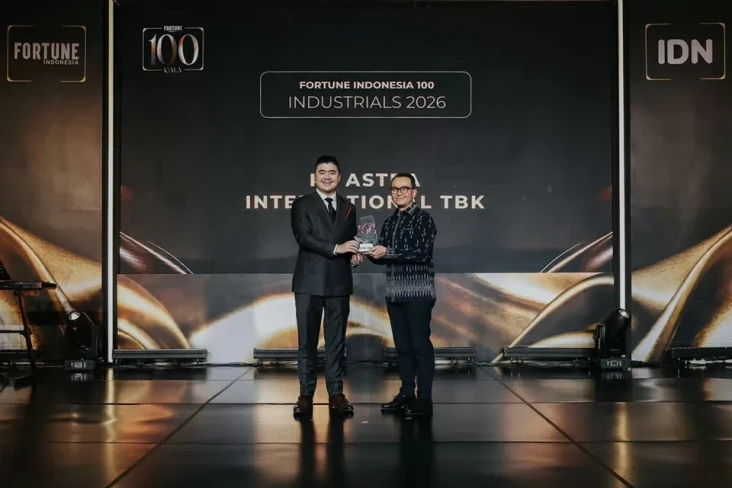
Astra ranked fourth in the 2026 Fortune Indonesia 100 and was also recognized as the recipient of the Fortune Indonesia Outstanding Growth 2026: Biggest Company by Total Employees award. The recognition was announced at the Fortune Indonesia 100 Gala in Jakarta on September 17, 2026. The ranking itself is based on audited 2025 financial statements, using indicators including revenue, net income, total assets, equity and market capitalization.
The scale behind the recognition is substantial. Astra currently has more than 190,000 employees and 324 subsidiaries, joint ventures and associated entities. Its activities cover three core businesses—Automotive, Financial Services, and Mining Solutions & Heavy Equipment—alongside a wider portfolio of businesses.

Such scale gives large corporations a particular relevance in discussions about economic resilience. Employment is one dimension, but the impact also extends through supply chains, financing, transportation, manufacturing, industrial services and consumer activity. For policymakers, the performance of large diversified groups can therefore intersect with broader questions surrounding investment, productivity and the resilience of domestic industries.
Astra’s own financial performance illustrates why diversification remains important. In 2025, the company recorded consolidated net revenue of Rp323.4 trillion and net income of Rp32.8 trillion. Net revenue declined 2% and net income declined 3% compared with the previous year, with weaker contributions from mining services, coal mining and the new-car business partly offset by stronger performance in financial services, gold mining and motorcycles.
The first half of 2026 continued to show different conditions across sectors. Automotive and Financial Services recorded increases in net income of 9% and 6%, respectively, while the contribution from Mining and Heavy Equipment Solutions was lower. These differences highlight how domestic consumption, commodity cycles, financing demand and industrial activity can influence different parts of the economy at the same time.
For policymakers across Asia, this type of corporate diversification is relevant because economic resilience increasingly depends on the ability of different sectors to absorb shocks at different stages of the economic cycle. A company operating across mobility, finance, mining, infrastructure and technology can encounter both risks and opportunities from developments that extend beyond a single industry.
At the same time, diversification does not eliminate the need for strategic discipline. In May 2026, Astra announced a strategic review as it approached its 70th anniversary. The company said it would place greater focus on its three core businesses, pursue more targeted development of its wider portfolio, and strengthen capital-allocation discipline.
The strategic direction is notable because it reflects a wider shift in corporate management across emerging Asian economies. As businesses become larger and more complex, maintaining a broad portfolio is increasingly accompanied by questions about where capital should be deployed, which capabilities should receive priority and how individual businesses contribute to long-term value creation.
The implications extend beyond corporate boardrooms. Astra’s businesses operate in sectors closely connected with public policy, including mobility, financial inclusion, industrial development, mining, infrastructure, technology and community development. The interaction between large private-sector groups and public priorities can therefore become an important element of Indonesia’s broader development trajectory.
Astra also links its corporate strategy with human-capital development. Through its People Roadmap, the company says it is strengthening a safe, inclusive, collaborative and sustainable working environment while developing employee capabilities and leadership. With more than 190,000 employees, the scale of these initiatives has implications for workforce development within the wider Indonesian economy.
The company’s social-development programs provide another example. Astra says its Desa Sejahtera Astra program has reached more than 1,500 villages across 35 provinces, focusing on health, education, environmental initiatives and entrepreneurship. The program is supported by nine foundations and forms part of Astra’s broader effort to contribute to inclusive economic development.
This approach reflects a broader understanding of corporate responsibility in emerging markets. As governments seek to strengthen local economies and improve community resilience, private companies increasingly operate alongside public institutions, civil-society organizations and local communities. The effectiveness of such collaboration depends not only on the scale of corporate resources but also on how consistently programs address local needs and generate sustainable economic activity.
Astra’s current position therefore offers a useful case study in the relationship between corporate scale and national economic resilience. Its Fortune Indonesia 100 ranking reflects its financial and organizational significance, while its strategic review demonstrates that scale alone does not remove the need to reassess priorities.
As Indonesia approaches another phase of economic transformation, the role of major domestic corporations will remain closely connected to questions of employment, industrial competitiveness, investment and sustainable development. Astra’s transition toward seven decades of operations provides one example of how a large Indonesian business group is attempting to balance those responsibilities while adapting its strategy to a changing economic landscape.